
The Bullet Holes We Don’t See: Survivorship Bias in Planning
During World War II, the military faced a critical puzzle.
Allied bombers were returning from missions riddled with bullet holes, mostly on the wings and fuselage. The commanders’ logic was simple: “Reinforce the wings. That is where they are getting hit.”
But a statistician named Abraham Wald stopped them. He pointed out a fatal flaw: they were only looking at the planes that had survived.
The planes hit in the engines or cockpit never came back. The damage on the returning planes simply showed where an aircraft could take a hit and keep flying. By reinforcing the wings, they would have wasted armor on non-critical areas while leaving the fatal weak points exposed.
They were analyzing the survivors, when they should have been thinking about the ghosts.
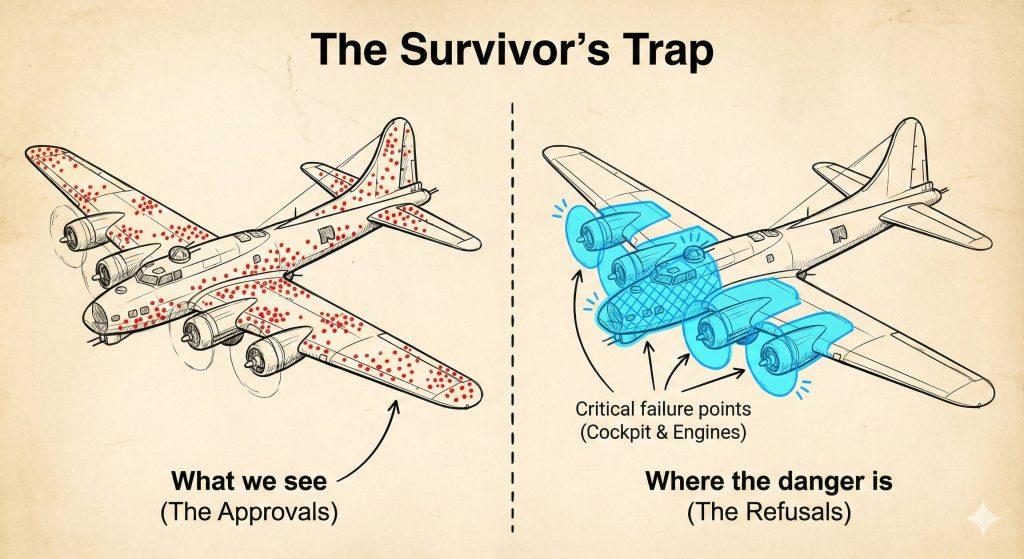
The Survivor’s Trap in Planning precedents
This “Survivorship Bias” is one of the biggest traps in planning.
When architects research a site, we typically look for Approved precedents. We say, “The neighbor got a 3-meter extension, so we can too.” We mimic the survivors, assuming that copying them guarantees safety.
But this tells us only what the Council tolerates. It doesn’t tell us what kills a project.
Why We Study the “Refusals”?
At JAIA, we look for the missing planes. To gain true Planning Intelligence, we actively study the Refused applications in the area.
By analyzing the failures, we find the invisible “bullet holes” that are fatal to a project. True intelligence isn’t just knowing what works; it’s understanding exactly where the fatal blow comes from. We don’t just add weight to our designs arbitrarily; we place our armor exactly where it is needed most.


