
The Horizon of Architectural Intelligence
If you draw a simple horizontal line across a page, you have created two states: above and below.
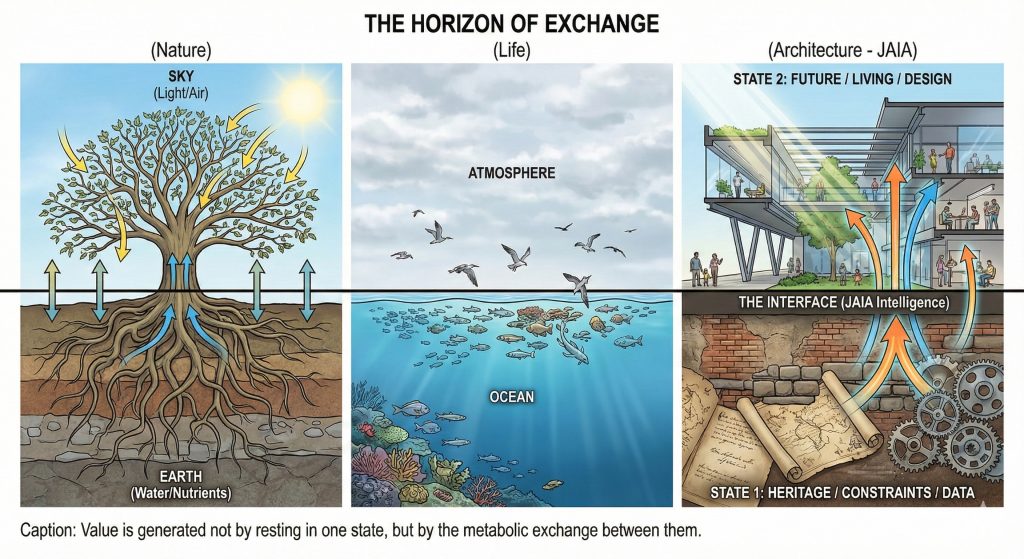
Consider a tree. It does not exist solely in the earth, nor solely in the sky. Its existence is defined by the metabolism across that horizon line. Its roots plunge deep below the line to trade for water and nutrients; its branches reach high above the line to trade for light and air. The tree is the exchange mechanism between dirt and sky.
We see this pattern everywhere in nature. The vast majority of ocean life does not reside in the abyssal deep, but in the epipelagic zone—the thin layer just beneath the surface where water meets sunlight. Similarly, birds do not live in the stratosphere, but in the thin layer of air just above the ground.
Life, energy, and value are rarely found deep within a homogenous state. They are concentrated at the interface—the messy, vibrant boundary where two different worlds meet and trade.
The Metabolism of Intelligence
In architecture, it is tempting to retreat into a single, comfortable state. Some practices exist entirely in the “state of the past,” specializing only in rigid preservation. Others exist entirely in the “state of the future,” interested only in tabula rasa new builds.
At JAIA, we believe that true Architectural Intelligence—like the tree—is a metabolism that must occur between different states. Value is not generated by staying in one realm, but by the friction and exchange across the borderline.
We operate on several of these horizon lines simultaneously:
1. The Interface of Time (Heritage vs. Future) Our work in London conservation areas is a metabolic process. We sink deep roots into the history, constraints, and materials of the Victorian fabric (the earth), to fuel modern, light-filled living spaces that reach for the future (the sky). We don’t choose between old and new; we facilitate the trade between them.
2. The Interface of Culture (East vs. West) Our practice embodies the exchange between the rapid, high-density urbanism of Seoul and the thoughtful, process-driven fabric of London. Our intelligence lies not just in knowing both systems, but in applying the lessons of one state to solve the problems of the other.
3. The Interface of Method (Hard Data vs. Soft Design) As discussed in our other articles, we work between the rigid state of raw data (planning policies, technical constraints) and the fluid state of human experience and creativity.
Catching the Value at the Edge
If you stay too deep in the earth, you starve of light. If you stay too high in the clouds, you wither from lack of sustenance.
The lesson of the tree is that vitality requires inhabiting the boundary. Architectural Intelligence is not a static possession; it is an active process of trading materials, ideas, and constraints across the horizon lines of our cities. That interface is where the energy is, and that is where we work.


